Friday, November 13, 2015

Co-evolution

In the activity we did about co-evolution each table was a different species of a bird. We were given either a fork, spoon, or knife which represented our beak. Then, we all gathered around on the floor and had to collect "food" for our species. The different foods were red beans, white beans, split peas, and macaroni. These represented different varieties of beans of the same species. After we collected our beans we went back to our tables and counted how many each group got. The first time nobody did very well, but as we went on more groups found ways to pick up the beans easier. Some people were using their legs or other people to get beans. Some people were working together. However, some species of the bird didn't do very well. By the end the knives barely stayed alive. The spoons did very well and the forks did pretty well. The spoons were the best adapted because of their beak shape. The beans also adapted. At the end of the activity there was a majority of split peas left (361). They were best adapted because of their shape. There are 5 red beans left at the end. They weren't adapted as well because of their shape and color. They were easy to see and pick up. The birds and beans evolved together as we went along with the activity, which is why it demonstrates co-evolution. This activity demonstrated natural selection because over time the knives dwindled but the forks and spoons got more "birds". Over time certain species of bird grew larger in number. I really enjoyed this activity. It got pretty competitive at times, but that is what happens in nature. The activity really helped me to understand this concept and what was happening. I love hands on activities and I would definitely use this in the future. 


This picture was the first time I collected beans. I didn't do very well, but over time I got a lot better at picking them up.


This photo was taken towards the end and is of all of the beans my group collected. We did very well.

Adaptation


In the activity we did about adaptation last week we had to create a unique environment and then another group had to design all of the organisms and vice versa. We needed 3 producers, 2 primary consumers, and 1 secondary consumer. In my groups environment, we had purple sugar water, mountains, and a warm temperature. The group that made our organisms made blue cacti with pink flowers, a type of sponge in the water and blue underwater trees. They also made a bug that ate the flowers from the trees and a fish that ate the bugs. There was also a very colorful bird that ate the plants and fish. I would say that they made the animals very well adapted to our environment. They worked with our terrain and water to make plants and animals that fit into it. The photo below is the environment that the other group created for mine. 


We also created organisms for another groups environment. The environment that they created had chocolate milk for the water and sugar lakes and rivers. They also created a rock, mountainous terrain. Their atmosphere had helium in the air so everyone sounded like munchkins. Their temperature was a little bit warmer than our earth now. We decided that since their water was chocolate, all the plants would have to be chocolate related and in turn the animals would be too because they are eating and drinking chocolate. The producers we created were a chocolate chip trees, a type of grass that has chocolate inside and a chocolate rose. The primary consumers were a "chubby bunny" and a chocolate trout or "chrout". Our secondary consumer was a cocoa bear. I thought our animals and plants we created were very well adapted to the other groups environment. At first it was kind of hard because they were based around chocolate but we ended up having a great time! Below is a photo of the environment we created for the other group.


Thursday, November 5, 2015

Meiosis

To model meiosis we used yarn just like for the mitosis activity. I have always been confused by meiosis and mitosis. Now I understand more about how they are related, but different also. Once meiosis occurs, then mitosis can happen. Meiosis is just for making the sperm or egg. I thought it was really interesting that the steps of meiosis have the same name as the ones of mitosis, except they have a 1 or 2 after them. (For example, Prophase 1) Another thing I found interesting is that when meiosis is complete you either end up with 4 sperm or 1 egg and 3 polar bodies. I never realized that happened. I thought you would get 4 eggs too if you got 4 sperm. Below are some pictures of the stages of meiosis modeled with yarn. 
Prophase 1

Metaphase 1

Anaphase 1

Telophase 1

Metaphase 2

Telophase 2

Making a Baby

Discuss the activity we did. Explain how it worked. What did you learn about genetics and offspring? Reflect on how "real" you think this is or is not. Was it fun? Would you use a similar activity in a classroom? Could it be adapted some way to be appropriate for younger (upper elementary) kids? 

Last week in class we "made a baby" with another person. It was really interesting. We had a list of traits that we had to say if we either had them or didn't. If the trait was homozygous or heterozygous for allele 1, we had to roll a coin to determine if it was homo or heterozygous. Below is the first page of traits that we used.
Once we each figured out our genotypes, we flipped a coin to see if our baby got the homo or heterozygous allele for each trait. We filled in a sheet that is shown below. Using the allele from Mom and Dad, we figured out the genotype and then what the phenotype would be for our baby.
This is what my parter and my baby would look like. 
I think that this activity was a great way to show genetics. Although you don't flip a coin with your parter to decide traits, it showed the random aspect. You don't know what traits your baby will get from you. Sure, it wasn't "real" but it gave me a greater understanding of how genetics work. I never really understood how you could get a trait that neither one of your parents have, and this activity helped me to see that. I would definitely use this activity in the future. Our class got really into it and had a great time. 

This activity could be modified for upper elementary students by making the number of traits shorter. I could do the first few with them so that they understand it too. 

Friday, October 23, 2015

Mitosis

This week in class we modeled the process of mitosis by using yarn and string. I would definitely use this in my classroom someday because it was really hands on and I could really see what was happening in each step. 


 First, the cell is in interphase. It is just doing cell things and not dividing. The DNA is represented by the little pieces of yarn.


Next, the cell begins replication. They create another DNA strand that is identical to the first.


Then, the cell enters prophase. In this stage, spindle fibers (the strings) connect to the centrioles to the chromosome. 


Here, the cell is in metaphase. The chromosomes all line up across the middle of the cell. 


Now the cell is in anaphase. The spindle fibers are shortening and pulling the identical chromosomes apart.


Finally, the cell goes through telophase. The DNA starts to turn back into chromatin, two nuclear membranes form, and the spindle fibers disappear.


Then the cell is in cytokinesis. The cell separates into two cells.


References:
http://prezi.com/qimmclxt061p/?utm_campaign=share&utm_medium=copy&rc=ex0share

Progeria

Progeria is an extremely rare disease of childhood that is characterized by extremely premature aging. It affects 1 in 4 million newborns. When a child is born it looks normal until about a year. Their growth rate slows down, and they are shorter and weigh less than other kids their age, but still have the same intelligence. Other symptoms include baldness, aged looking skin, pinched nose, small face, stiffness of joints, hip dislocation, and severe progressive heart disease. The most severe type is Hutchinson-Gilford progeria syndrome. There is no treatment or cure, but the children can get heart surgery to slow down heart complications. The average age of death is 13, and is usually caused by heart attack or stroke.

Researchers have found that Hutchinson-Gilford progeria is caused by a tiny mutation in a single gene called lamin A (LMNA). Parents and other siblings are usually never affected by the disease. They found that the mutation happens in the sperm prior to conception. In almost all cases this arises from the substation of one base pair among 25,000 DNA base pairs that make up the LMNA gene. The LMNA gene codes for lamin A and lamin C which are known to stabilize the inner membrane of the cell's nucleus. The progeria gene causes the LMNA to produce an abnormal form of the lamin A protein. This destabilizes the cell's nuclear membrane and is harmful to tissues that are usually subjected to instances physical force (cardiovascular and musculoskeletal). This is why they are so small and have heart issues. Also, the LMNA gene is also responsible for at least 6 other genetic disorders, including muscular dystrophy. 


"Progeria" by See SourceMinor edit by Mikael Häggström - The Cell Nucleus and Aging: Tantalizing Clues and Hopeful Promises. Scaffidi P, Gordon L, Misteli T. PLoS Biology Vol. 3/11/2005, e395 http://dx.doi.org/10.1371/journal.pbio.0030395. Licensed under CC BY 2.5 via Wikimedia Commons - https://commons.wikimedia.org/wiki/File:Progeria.png#/media/File:Progeria.png

Resources:
http://www.genome.gov/11007255

Monday, October 12, 2015

DNA Discovery

In this activity we made DNA strands out of candies and toothpicks. Each candy represented something that makes a DNA strand. Red jolly ranchers and orange gummy bears went together and green jolly ranchers and red gummy bears went together. Once we built up the DNA strand, we broke the toothpicks in half and then replicated the strands. This whole process is shown in the photos below.


From this activity I learned that there can be up to 3000 proteins in a gene. As for the structure of DNA: A=T and C=G. Those are the only patterns that the bases can be in, so a T couldn't be with a C or an A couldn't be with a G. The DNA strand is in a double helix shape. When the DNA replicates, it is done in a semi-conservative way. This means that half of the DNA is kept the same during replication.

In the 1950's, Watson and Crick were studying the structure of DNA. They used data from Franklin and Wilkins. Franklin took the original picture of the DNA structure and then Wilkins showed Watson and Crick the picture.

Pond Water

In class last Thursday we got to look at pond water through a microscope. I thought it was super cool! There were so many little creatures and things to see in just one tiny drop. It kind of grosses me out that there is that much stuff in the water when I am swimming though. There were a lot of moving organisms but also a lot of algae and rocks. I saw a lot of filamentous green algae. That was easy to identify and looked really cool close up. The flatworm that I saw was really cool when it moved around because it was flat and then all of a sudden it was a weird long shape and then it would get flat again. The round worm was the grossest thing. It just slithered around and kept appearing. We kept trying to chase it around the slide. I also found this creature that looked like a little see-through crab. I looked it up and found out that it was most likely a water flea. The last organism that I identified was a green algae with flagella. It moved fast and looked kind of gross too.

Water fleas can live in a variety of places such as acidic swamps or freshwater lakes, ponds, rivers and streams. Their eggs are enclosed in a shell that protects them. Their life spans range from 5-6 months to 13-15 months. Water fleas eat mostly algae, protists and bacteria.


This is a picture of what my groups pond water looked like through the microscope.

Wednesday, October 7, 2015

Chain Factory

This activity was really fun and entertaining. I was the custodian (or lysosome) and had to pick up the little green pieces of crumpled up paper that represented energy. While the activity was going on I had no idea what we were doing it for. Once we found out we were representing a cell, it made more sense. Each person had a job that corresponded to a function of the cell. The "factory" that we were in was making chains to send to party stores, and the chains represented proteins that are made in the cell. It was really interesting how each thing really showed what the organelles in a cell do. Once we were done with the activity we got to discuss with our group what each job represented. If we would have just read about each function I think it would have been harder to understand what each of the processes were, but because we could relate them to something we had just physically done it was easier.

Thursday, October 1, 2015

Project Blog 1

After writing your full proposal reflect here on what you think will happen, what you think your challenges will be, what you are concerned about, etc. 

In our project we are going to see how different plants affect the bacteria population in the soil they are living in. We are using sunflowers, grass, green beans, and radishes as our plants. I think that all of the plants will add bacteria, but in different amounts. I have read that legumes add a lot of bacteria, so I think the green bean soil will have the most. I am concerned that our plants aren't going to grow or something is going to happen to them, like someone else coming in and messing with them. I think those could also be our challenges. Another challenge could be the plants not getting enough or the same sunlight or water. I feel like we are going to have to be very careful about that. I think our project is going to go well. I am very excited to get started and see the amounts of bacteria and our plants grow. I hope that we get good results! 

Monday, September 28, 2015

Food Web

Last week in class we simulated a food web. We made a huge list of animals that live on Presque Isle and then each chose one single animal to research what it ate. We could only include animals that were on our list of ones that we chose, so there were only about 20. If we would have included all of the animals our food web would have been huge. Then, we each got a notecard and wrote the name of our animal on it with what it ate (of the things on our smaller list). I had a bat. Then we attached strings to the notecard for each organism that the animal ate. I only had one because I found that the only thing that Michigan bats eat on our list was hornets. Then we went outside and connected all of the strings.


As you can see, our web was a big, tangled mess. I learned that food webs are not nice and neat like food chains. But food webs are more accurate because a certain animal eats more than one thing. Then, we took one animal out of the food web. 
We found out that if that actually happened, none of the other animals would be able to survive. If one animal was taken out of the community, nothing else would be able to survive because everything relies on another animal to survive. The food web would collapse. I thought this was really interesting and eye opening. I had never thought about it like that. Each animal on Presque plays an important role in the community. 

New Celebration

Last night there was a lunar eclipse and I was lucky enough to see it. I was talking to my parents on the phone and had a perfect view of the moon rising into the sky. It was huge and my picture doesn't do it justice.
Picture- Katie Cattani
My friends and I headed down to McCarty's Cove a little after 8, right as the eclipse was starting. I made my boyfriend come instead of watching football games because I wanted as many people as possible to be able to see it. We got to watch the moon disappear and then turn reddish. It gradually got thinner and thinner but I could still see the outline of where it originally started. It was so cool.  I am really happy that I got to witness this eclipse. This experience was definitely a celebration. One of my friends, friends has a telescope and took some really cool pictures that she said I could also include in my blog. One of my other friends has a really nice camera and he also sent me pictures to use.

Pictures- Amanda Bink


Up and down photos: Trevor LaCombe 


Saturday, September 26, 2015

Chernoff Faces

Last week we did an activity called Chernoff faces. One by one we were given a category and eventually had a face. First we had to get our face shape. A sideways oval meant you were from the lower peninsula, up and down oval for the upper peninsula and circle for anywhere else. Your major or minor determined your eye shape. Sideways oval for special education, up and down oval for science or math, or circle for language arts, social studies or anything else. Preferred sports determined the pupil. Sideways oval for individual sports, up and down oval for team sports or circle for X-games. Your preferred food determined your mouth. Sideways oval for Chinese foods, up and down oval for Mexican, or circle for Italian. Your ears were determined by your music preference. Sideways oval for rap or hip hop, up and down oval for rock or pop and circle for country. Finally, your nose was determined by your preference of pets. Sideways oval was a bird, up and down oval was a rodent or rabbit, and a circle was reptiles. These were my groups final products.


 After everyone in the class had their head, we classified ourselves into different groups. First, by face shape, or where we were from. Then we classified by mouth shape, or food preference. Finally we got into groups based on nose, or animal preference. From this activity I learned that sometimes we can classify things and people in many different groups. Some things don't belong in just one group, like our faces. We could have made even more groups. I don't think anyone in the class had the same face, which was cool.

Presque Isle Community Ecology

  • Presque Isle is a great example of a community. A community is a smaller area in an ecosystem where living things interact. At Presque, an example of parasitism would be ticks. The ticks feed on animals and people and is benefited, but the organism it is feeding on is harmed but not killed. An example of commensalism would be a chickadee nesting in a tree. The tree is harmed, but the chickadee isn't harmed or benefitted. An example of mutualism would be deer eating grass. They are both benefitted! An example of intraspecific competition on Presque could be the deer. They are all competing for resources, and they all need the resources to survive. An example of interspecific competition wolves and foxes. They could fight for resources, habitat, or territory of the island. Presque would be considered a microhabitat because it is very different than the surrounding area. It is pretty much right in a city. The animals that live there probably don't spend much time in the city part of Marquette. The plants there are also pretty much only in that area. Marquette is a very nature filled town, but Presque Isle is the most diverse in a small area. 

  • The niche of a  whitetail deer:
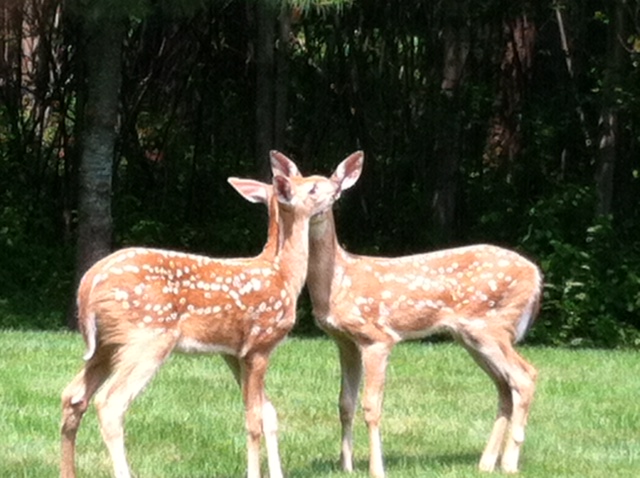
Deer are herbivores so they eat grasses, plants, and nuts. The live in forest areas and can get eaten by mountain lions, coyotes, and wolves. The females give birth to fawns, which are pictured in my photo that was taken in my backyard at home. 


What's Alive?

In the "What's Alive?" activity, we were given beans, corn, a piece of straw, a cotton ball, toothpick and, rocks. We also had to go outside and find two living things. My group found a beetle type thing and a moth. We had to classify each thing as living, never living, once was living or comes from a living thing. After we classified, everything went inside a piece of wet paper towel, was wrapped up, and placed in a plastic baggy where it sat in the classroom window for a week. Then, we got to open the baggies and see what was living. Our moth and beetle were both dead, sadly, but what we found inside was so cool.


The beans and corn had grown roots! I should've known that was going to happen, but I really didn't realize it at the time. The root system was so large and complex, it was amazing. I thought this was a really cool activity and I will definitely use it someday in my classroom. I learned that even though something might seem like it is dead now, it is actually living. We had classified the beans and corn as once living things, when they were actually alive. 


Friday, September 25, 2015

Odyssey- A Sand County Almanac

After reading Odyssey from Aldo Leopold's book, A Sand County Almanac, I think that it is possible that the element or molecule that X and Y are represented by is H2O. Or maybe it is just hydrogen, or just oxygen. It is hard to tell, but we know that this molecule helps initially build a flower that eventually feeds an Indian, after going through a few stages. It is kind of crazy and mind blowing to think about how a single molecule can go so far. I would love to know where each atom and molecule that is inside of me has been. I have no clue, and they could have come from somewhere across the world. It can depend on the air I breathe, what I eat, what I drink, among other things. Another section of this reading talks about a plants roots and pumping nitrogen out of the air and into the plant and eventually into the soil. This is how the prairies get their nitrogen rich soil, from legumes. We talked about the nitrogen cycle, and it can be related to this passage. It also references the water cycle. The passage talks about a molecule in the soil getting carried downhill by rain. Plants get "impounded" by atoms (rain). Even when animals or plants die, the atoms get reused by other things. They go back into the soil and could create a plant, which feeds animals, which feed humans. Everything in the world is interconnected. All of the cycles work together to make life. If we got rid of say, the water cycle, there would be no life on earth. Each cycle plays an important part, and each atom or molecule plays an important part. 
This photo I took of the Brule River makes me think about a molecule in there and how far it must go before something interferes with it and it gets picked up and taken somewhere else. 

Thinking Like a Mountain

In Aldo Leopold's book, Sand County Almanac, he talks about how a mountain is really the only thing that has lived long enough to see everything that happens and the hidden meanings in nature. Then Aldo talks about the time he saw a wolf die and how that was his realization that there is more to nature than the physical things. In those days, people always killed wolves if they saw them. Him and his friends (I assume), watch wolves playing on the mountain. They decide to start shooting, and end up hitting an old wold and a pup. The pups foot was injured so he limped away, but the old wolf was going to die. Aldo says that he watched a green fire dying in her eyes. It was at that moment that he realized that killing wolves didn't mean more deer and a hunters paradise and that it meant more to the wolf and mountain too. Now, he watches more and more states kill off wolves and the deer eating all of the food in the area and then die. Trees no longer have their leaves because of all of the deer eating them. A deer killed by wolves can be replaced in two to three years, but it takes a long time for deer to be replaced when they die from hunger or things other than predators. The mountain knows more than men.

I had to read this book for an environmental science class last year, so I already kind of knew what it was about. I think it is sad and really something to think about. I think that more people need to think more like a mountain and less about themselves. We need to take a step back and let nature take its course. I think that humans interfere too much with natural processes these days. Like this section said, it takes less time for deer to make up for loss when they are killed by wolves but it can take decades to make up for loss by starvation. I don't think people know that if they are making decisions to kill off the wolves. Before I read this, I probably would've said to kill off wolves too so that there are more deer to hunt and so they aren't getting killed. But now I think wolves are an important part of the ecosystem and an important part of deer lives. I don't think there should be a wolf hunt in the UP for those reasons. We really just need to let nature take its course. Nature knows more than we do. To think like a mountain, I think we need to think about how we are affecting the ecosystem and area that we live in. We need to observe on the processes and know that every living thing plays a part, whether it is good or bad to us. I really strongly believe that everyone should read this passage and reflect on it.


 This is a picture of a deer in my back yard at home.

Friday, September 18, 2015

Bog Walk

We also went to the bog walk last week at Presque Isle. Bogs collect over thousands of years at the bottom of ponds. Bogs go through succession over time. They gradually go from a pond to having many trees and plants. This bog is beginning to have many different kinds of plans and trees. It has some big trees so it is pretty far in its succession.

I saw so many interesting things. I had never been to the bog walk before, but now I would love to go back. I saw so many plants that I have never heard of before like the pitcher plant. These plants have a slippery substance on their leaves that attract bugs. The bugs get attracted and just slide in and can't get back out.

At one point, we were walking and came to some sand dunes. We walked over and found the beach on Lake Superior. It was so beautiful. It was a beautiful day, so that just made it even more picture perfect. I have been to that beach before but I never knew that the bog walk was just right behind. One of the plaques with information it it said that the grasses are what hold the sand in place and create the dunes. Over time the dunes can grow, shrink, or move depending on the environment. I would love to see what this area looked like 50 years ago and what it will look like 50 years from now. I hope that I will be able to see that.

 We also found a beaver dam. That was really cool. Those beavers must put so much time and energy into their houses. I also saw a trees that a beaver had chopped down. It is crazy how an animal that small can do so much damage and take down huge trees.


 I had a great time at the bog walk. I would love to take my friends here to show them. It has lots of cool things to see but you also can learn something new.

Small Plot at Presque

Last week we went to Presque Isle for class. One of the activities we did was observing a small plot of land. We got a piece of purple string and had to make a square that we would observe for a half hour.

Some observations that I made about the plot were that there were leaves, bark, sticks, pine cones, green and brown pine needles, a half eaten pinecone, and a rock with green moss. The plot was under a maple tree so it was shady. The mosquitos were out and biting. It was also pretty windy that day but quiet in the woods where we were. At first the time was going by really slow but then it started going faster when we noticed a little red spider inside of our plot.

It is kind of hard to see in the picture but it is the little red dot almost in the middle. He was really speedy and hard to keep track of. When I lost where he was it was fun to find where he was again. He was easy to spot on the white birch bark, and he spent a lot of time there. He also was on a pine needle at one point crawling all around it. When our time was up we lifted up a piece of bark and found a worm.

This activity was really relaxing, but interesting at the same time. I always like sitting in nature and observing what happens. I learned that sometimes it takes a while for things to "interesting" things to happen. Nature is a beautiful thing and there are always little creatures crawling around or huge trees to observe.